


Entity-Based SEO for LLMs: How to Build Brand Depth AI Trusts
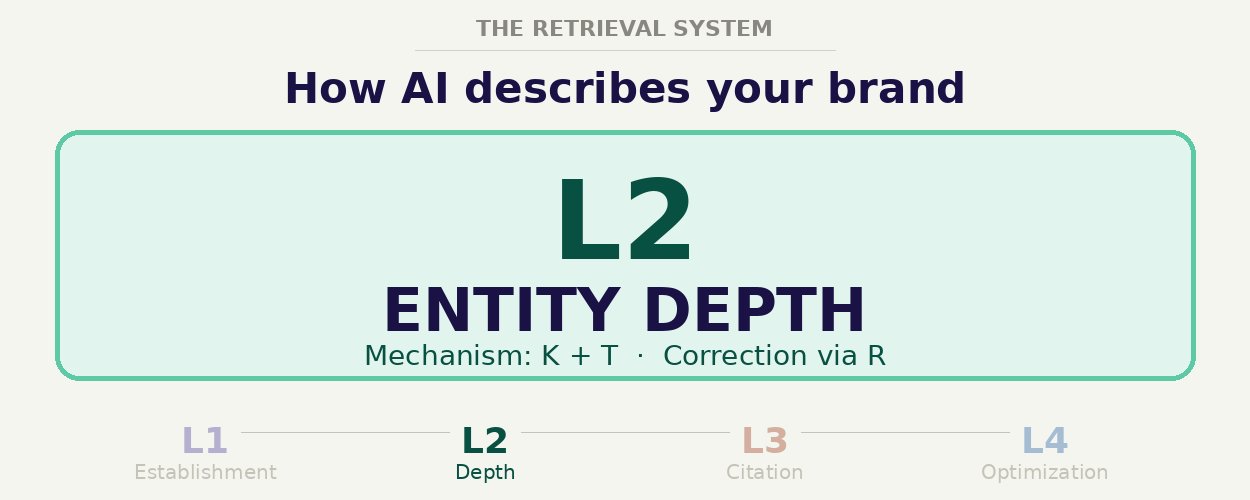

The L2 framework post covered what entity depth is and why the training layer matters. This is the tactical version. What to do about it, based on where you are and what kind of company you run.
Quick recap: L1 is whether AI knows you exist. L2 is whether it knows you well enough to describe you accurately and recommend you confidently. The difference shows up in how AI hedges. Weak L2: “Some users have reported that [brand] offers…” Strong L2: “[Brand] is a leading provider of…” Same brand. Same query. The confidence gap comes from how much depth the model has in its training data about you.
L2 is powered primarily by mechanism K (knowledge — what’s baked into training data) and mechanism T (training — how that data shapes the model’s representations). This is the layer where your brand’s digital footprint over months and years compounds into the model’s baseline understanding of who you are.
If L3 is about getting cited in the moment, L2 is about building the foundation that makes those citations confident instead of hedged. Pound it into their heads.
Step 1 for everyone: check how AI describes you right now
Open ChatGPT, Gemini, and Perplexity. Ask each one:
“What is [your brand]?” “Tell me about [your brand]” “What does [your brand] do?” “What is [your brand] known for?” “How does [your brand] compare to [competitor]?”
Write down exactly what each platform says. Pay attention to three things:
Accuracy. Is the description correct? Right products, right positioning, right location, right pricing tier? Or is it pulling from outdated info, mixing you up with a similarly named company, or hallucinating details?
Confidence. Does it describe you with authority or hedge everything? “Is known for…” vs “appears to offer…” The hedging tells you your L2 is thin.
Consistency. Do all three platforms describe you the same way? If ChatGPT knows your product line but Gemini thinks you’re a different company, your entity signals are fragmented.
This is your L2 baseline. Everything below is about improving it.
The two sides of L2
L2 has a training side and a correction side. Most companies need both.
The training side is about feeding the model more depth over time. More mentions on authoritative domains. More structured data. More consistent descriptions across the web. This compounds slowly — models retrain on cycles, not in real time.
The correction side is about fixing what the model already believes wrong. This works through the retrieval layer (mechanism R) as a bridge — publish correction content, AI retrieves it, the wrong description gets displaced. But retrieval corrections fade. Long-term correction requires the training side to eventually absorb the accurate information. It’s a process.
proved both sides in one experiment. A single 2018 negative review duplicated across 5 sites was showing up in 38% of branded prompts. They published correction content with real retention data. Perplexity cited it the same day. After 2 citations, LLMs stopped referencing the misconception. But it faded — they had to republish to maintain it. The retrieval fix was fast. The training fix takes time.@wilreynolds
If you’re SaaS or B2B
Your L2 targets are press coverage, structured data consistency, Wikipedia/Wikidata, and authored expertise content.
𝗣𝗿𝗲𝘀𝘀 𝗮𝗻𝗱 𝗲𝗮𝗿𝗻𝗲𝗱 𝗺𝗲𝗱𝗶𝗮. This is where press releases actually work. Not for L3 category citation (0 out of 300 in our testing). For L2 entity depth. When your brand gets mentioned on AP News, TechCrunch, or industry publications, that mention enters the training data. The model learns you exist, what you do, and who talks about you.
The key: press mentions build the K layer. The more authoritative the domain, the more weight the mention carries in training. A TechCrunch feature teaches the model more about your entity than 50 blog posts on low-authority sites. Quality over quantity. Earn coverage that names your brand, describes what you do specifically, and includes your category label explicitly.
𝗦𝘁𝗿𝘂𝗰𝘁𝘂𝗿𝗲𝗱 𝗱𝗮𝘁𝗮 𝗰𝗼𝗻𝘀𝗶𝘀𝘁𝗲𝗻𝗰𝘆. Every directory, profile, and listing that describes your brand is potential training data. If your Crunchbase says you’re a “marketing platform,” your LinkedIn says “growth agency,” and your About page says “visibility company,” the model averages those signals. The result is a blurry entity description.
Audit every public profile. Crunchbase, LinkedIn company page, G2, Clutch, AngelList, your Google Business Profile, industry directories. Make the category label, company description, and positioning consistent across all of them. LLMs can’t represent typicality within categories — explicit, consistent labeling is what pulls your embedding closer to the right category.
𝗪𝗶𝗸𝗶𝗽𝗲𝗱𝗶𝗮 𝗮𝗻𝗱 𝗪𝗶𝗸𝗶𝗱𝗮𝘁𝗮. Wikipedia is one of the highest-weighted sources in LLM training data. If you have a Wikipedia page, the accuracy and completeness of that page directly shapes how AI describes you. If you don’t, and you meet notability requirements, this is worth pursuing. Wikidata is the structured data layer underneath — your entity’s properties (founded date, headquarters, founder, industry, products) feed Knowledge Graph resolution.
Don’t create or edit your own Wikipedia page. That violates Wikipedia policy and usually gets reverted. But you can ensure the third-party sources that Wikipedia would cite (press coverage, industry reports) exist and accurately describe your brand.
𝗔𝘂𝘁𝗵𝗼𝗿𝗲𝗱 𝗲𝘅𝗽𝗲𝗿𝘁𝗶𝘀𝗲 𝗰𝗼𝗻𝘁𝗲𝗻𝘁. When your founder or team publishes expertise content on authoritative platforms — guest posts, industry publications, conference talks that get transcribed — those create entity-person-brand associations in training data. The model learns that [person] is associated with [brand] and [topic]. This strengthens both the entity (L2) and the topical authority that feeds L4 informational citation.
Author schema on your own site matters here. Full Person markup with jobTitle, affiliation, sameAs linking to LinkedIn and X profiles. The model connects these signals across sources.
If you’re ecommerce or DTC
Your L2 targets are product-level entity depth, brand narrative consistency, and review ecosystem health.
𝗣𝗿𝗼𝗱𝘂𝗰𝘁-𝗹𝗲𝘃𝗲𝗹 𝗲𝗻𝘁𝗶𝘁𝘆 𝗱𝗲𝗽𝘁𝗵. For ecommerce, the entity isn’t just your brand — it’s each product. AI needs to know what each product IS, what attributes it has, what category it belongs to, and how it compares. Product pages with vague marketing copy build no entity depth. Product pages with specific specs, materials, dimensions, pricing, and use cases build depth the model can use.
Schema markup here is critical. Product schema with every attribute populated. Not just name and price — aggregateRating, brand, material, color, size, weight, category. The more structured attributes, the more the model can confidently describe and compare your products.
𝗕𝗿𝗮𝗻𝗱 𝗻𝗮𝗿𝗿𝗮𝘁𝗶𝘃𝗲 𝗰𝗼𝗻𝘀𝗶𝘀𝘁𝗲𝗻𝗰𝘆. Same as SaaS — if your brand is described differently across every platform, the model builds a blurry entity. Your Amazon storefront, Shopify pages, social profiles, and press mentions should all describe the brand the same way. Same category labels, same positioning language, same core attributes.
𝗥𝗲𝘃𝗶𝗲𝘄 𝗲𝗰𝗼𝘀𝘆𝘀𝘁𝗲𝗺 𝗵𝗲𝗮𝗹𝘁𝗵. Reviews are training data. The sentiment, language, and product attributes mentioned in reviews shape how the model describes your products. A product with hundreds of reviews mentioning “comfortable” and “durable” will have those attributes baked into its entity representation. A product with reviews mentioning “broke after a week” will too.
You can’t control what people write. But you can influence the volume and recency of reviews (ask after positive outcomes), and you can respond to negative reviews with accurate, specific correction data — which itself becomes training data.
If you’re local or service-based
Your L2 targets are Google Business Profile depth, review consistency, and local citation accuracy.
𝗚𝗕𝗣 𝗮𝘀 𝗲𝗻𝘁𝗶𝘁𝘆 𝗱𝗮𝘁𝗮. For local businesses, GBP is probably the single most important L2 source. Every field you fill is entity data the model can use. Services, products, attributes (wheelchair accessible, free wifi, outdoor seating), business hours, service area, payment methods. The more completely you describe yourself, the more confidently AI can describe you.
Posts on GBP count too. Regular posts with category-relevant content signal an active, current entity.
𝗟𝗼𝗰𝗮𝗹 𝗰𝗶𝘁𝗮𝘁𝗶𝗼𝗻 𝗰𝗼𝗻𝘀𝗶𝘀𝘁𝗲𝗻𝗰𝘆. NAP (name, address, phone) consistency across all local directories has always mattered for local SEO. Now it matters for entity resolution too. If your name is spelled differently on Yelp vs Google vs your website, the model may not confidently resolve these as the same entity. Inconsistent data creates a fragmented entity.
𝗥𝗲𝘃𝗶𝗲𝘄 𝗹𝗮𝗻𝗴𝘂𝗮𝗴𝗲 𝗮𝘀 𝘁𝗿𝗮𝗶𝗻𝗶𝗻𝗴 𝗱𝗮𝘁𝗮. The language in your reviews teaches AI what your business is known for. A restaurant with reviews consistently mentioning “best tacos in the neighborhood” builds that association into its entity. When someone asks AI “best tacos near me,” the model’s confidence in recommending you comes partly from the training-layer associations built from those reviews.
This is a long-term signal. You can’t manufacture review language overnight. But you can make it easier for customers to leave reviews (QR codes, follow-up emails), and you can ensure your own content uses the same language you want associated with your brand.
If you’re an agency or consultancy
Your L2 targets are thought leadership authority, client proof, and entity-person-brand associations.
𝗧𝗵𝗼𝘂𝗴𝗵𝘁 𝗹𝗲𝗮𝗱𝗲𝗿𝘀𝗵𝗶𝗽 𝗮𝘀 𝗲𝗻𝘁𝗶𝘁𝘆 𝗱𝗲𝗽𝘁𝗵. For agencies, L2 is heavily tied to the people behind the brand. When your founder publishes research, speaks at conferences, gets quoted in industry articles… each instance builds entity depth for both the person AND the agency. AI learns: [person] is the founder of [agency], [agency] specializes in [category], [person] is an expert in [topic].
This is why thought leadership isn’t just marketing. It’s entity infrastructure. Every published piece, every conference talk, every podcast appearance adds a layer to how confidently AI describes you.
𝗖𝗹𝗶𝗲𝗻𝘁 𝗽𝗿𝗼𝗼𝗳 𝗮𝘀 𝗲𝗻𝘁𝗶𝘁𝘆 𝘀𝗶𝗴𝗻𝗮𝗹. Case studies on your site help, but they’re first-party content. What builds L2 more effectively is when clients mention you publicly — in their own content, in press coverage, in interviews. Third-party mentions on authoritative domains carry more training-layer weight than anything you publish about yourself.
Make it easy for clients to reference you. Provide quotes, co-publish results, offer to be named in their press releases.
𝗘𝗻𝘁𝗶𝘁𝘆-𝗽𝗲𝗿𝘀𝗼𝗻-𝗯𝗿𝗮𝗻𝗱 𝗮𝘀𝘀𝗼𝗰𝗶𝗮𝘁𝗶𝗼𝗻𝘀. AI connects entities through co-occurrence. When your agency and your founder consistently appear together in authoritative contexts, the model builds a strong association. When your agency and a topic (say, “link building” or “AI visibility”) consistently co-occur, the model builds category authority.
Be deliberate about which associations you’re building. Every public mention is a training data point. Every one is teaching the model what to associate with your brand.
The maintenance problem
L2 doesn’t set and forget. The Wil Reynolds experiment proved this — retrieval-layer corrections fade over time. Training-layer depth is more durable but not permanent. Models retrain. New data enters. Old data gets weighted differently.
Quarterly check: run the same diagnostic from Step 1. Has the description changed? Is it still accurate? Has a competitor’s growth displaced your entity depth in the category? Has outdated information resurfaced?
If descriptions have degraded, publish fresh authoritative content that restates your current positioning. Update your structured profiles. Get recent press coverage. The training layer needs fresh signal to maintain accuracy.
How L2 connects to the rest of the stack
L2 is the confidence layer. Without it:
L3 category citations get hedged. AI retrieves a listicle mentioning your brand but doesn’t recommend you confidently because it doesn’t have deep entity knowledge.
L4 informational citations don’t happen. AI won’t cite your content as a source on a topic if it doesn’t have training-layer confidence that you’re an authority on that topic.
L1 gets you in the door. L2 makes you credible once you’re inside. Everything above L2 in the stack depends on it.
Build the depth. Maintain it. The model’s confidence in your brand is a direct function of how much it knows about you — and how consistently that knowledge tells the same story.
, 15K queries. 12% cross-platform citation overlap. BrightEdge + Relixir. Schema: attribute-rich helps, generic hurts. Growth Marshal, 730 citations. Generic schema 41.6% citation rate vs 59.8% no-schema baseline. Direct platform testing, Mar 2026. Press releases feed L2 (training) not L3 (retrieval).Sources referenced:@wilreynolds/ Seer Interactive, 2026. Brand correction GEO experiment. 38% branded prompt appearance, 2-citation fix, correction fade requiring maintenance. Shani/LeCun/Jurafsky, ICLR 2026. Explicit category labeling — LLMs can’t represent typicality within categories.@hq_passionfruit+@ahrefs
Written by Aaron Haynes on April 13, 2026
CEO and partner at Loganix, I believe in taking what you do best and sharing it with the world in the most transparent and powerful way possible. If I am not running the business, I am neck deep in client SEO.